


We review data from 1,700+ dealerships nationwide to create a quarterly report that outlines top trends in metrics like F&I product penetrations, PVR, deal mix and more. Discover the statistics that are impacting dealers below, then compare the data with your own to help plan for your dealership's success.
Now at the midpoint of 2026, the industry continues to feel the effects of global uncertainty, shifting market conditions and ongoing financial pressure. Consumers are adapting their purchasing behavior in response to these constraints. While challenges persist, dealers remain well-positioned to drive retention and enhance the customer experience. Let’s examine the key data from Q2 and identify opportunities to build momentum in the second half of the year.

Key Automotive Trends in Q2 2026
- F&I PVR Remains Elevated YOY
- VSC Penetration Fluctuates but PPD Ahead YOY
- Hybrid Sales Are Growing
Data reflects only dealers currently offering JM&A products and is not representative of nationwide dealer performance. Economic insights are not real-time and are generally updated quarterly. Projections involve assumptions and uncertainties and are not guarantees of future results actual outcomes may differ materially. The content is provided for informational purposes only, does not constitute legal, financial, or compliance advice, and should not be relied upon without independent professional review.
Dealership Performance and Profitability Trends
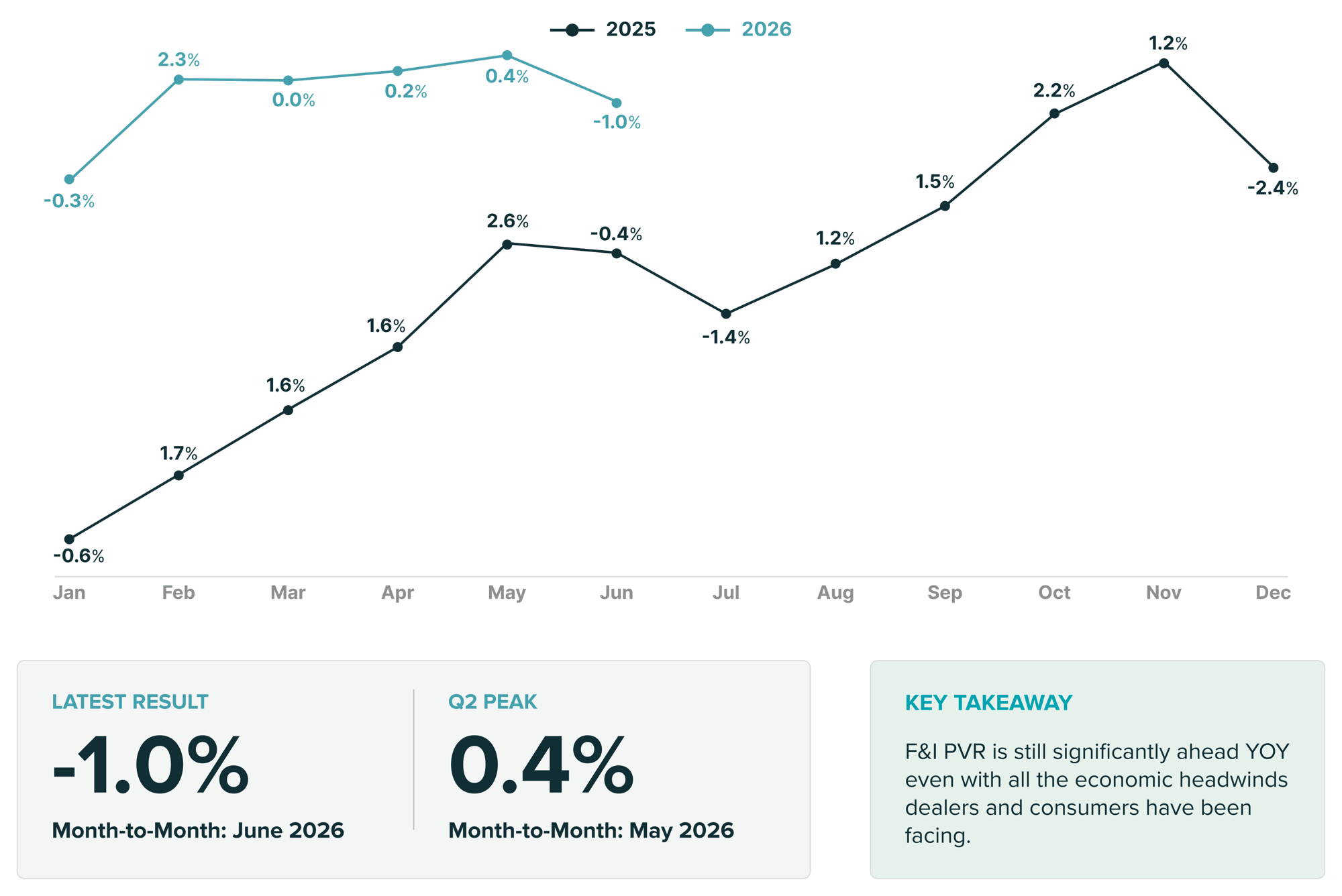
F&I PVR Remains Elevated YOY
F&I PVR is still significantly ahead year-over-year, even with all the economic headwinds dealers and consumers have been facing. A bit of a summer slump is not unusual and is comparative to last year.
F&I PVR
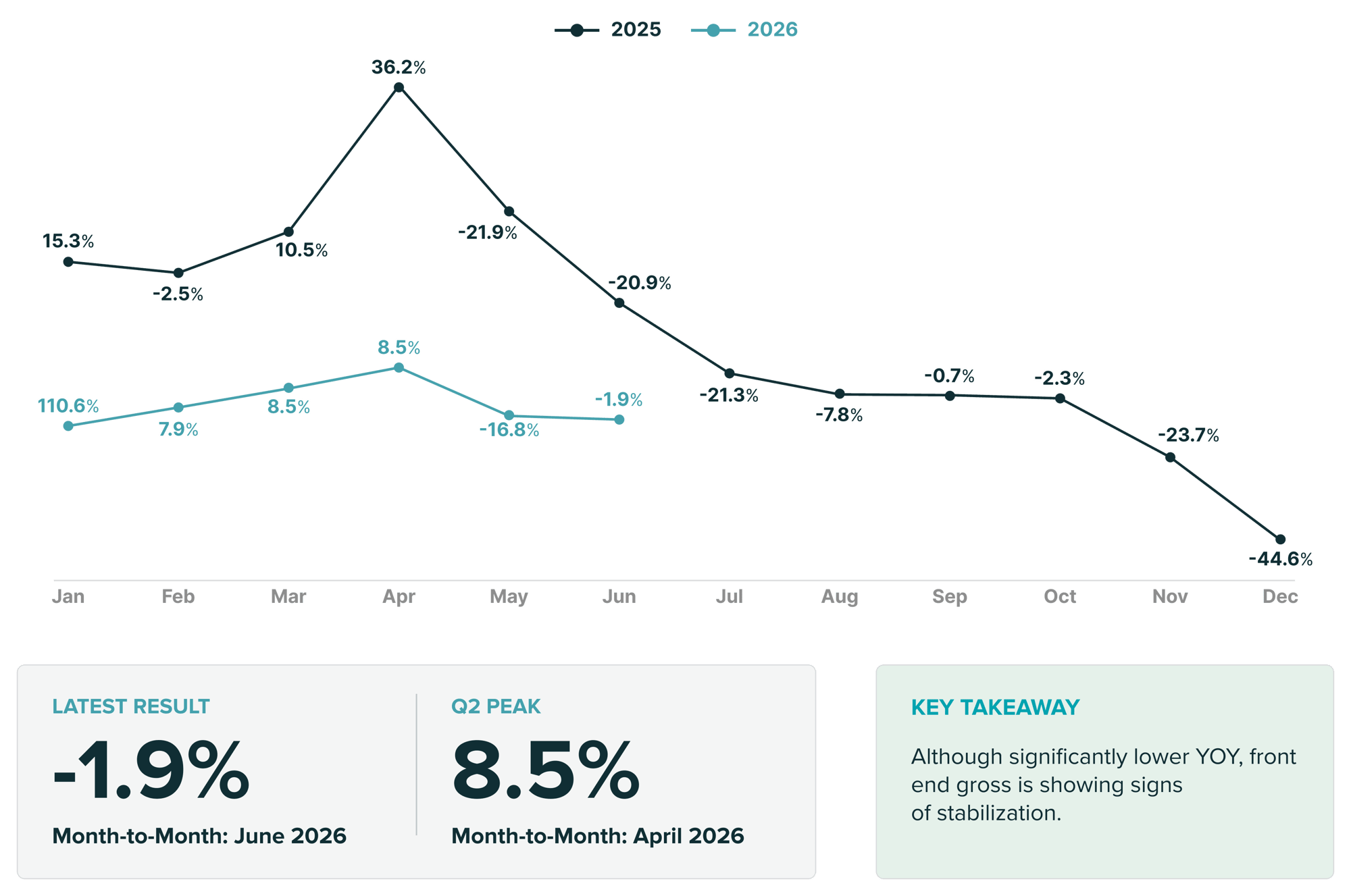
Front PVR Data Shows Pressure Amidst Affordability Challenges
Although significantly lower YOY, front end gross is showing signs of stabilization.
Our Take: In the next quarter we don’t expect to see significant increases in front end gross as inventory is stable (although varied by brand) and affordability issues persist. F&I will remain a crucial lever for profitability opportunities, along with your fixed ops department.
FRONT PVR
FRONT PVR 2019/2026
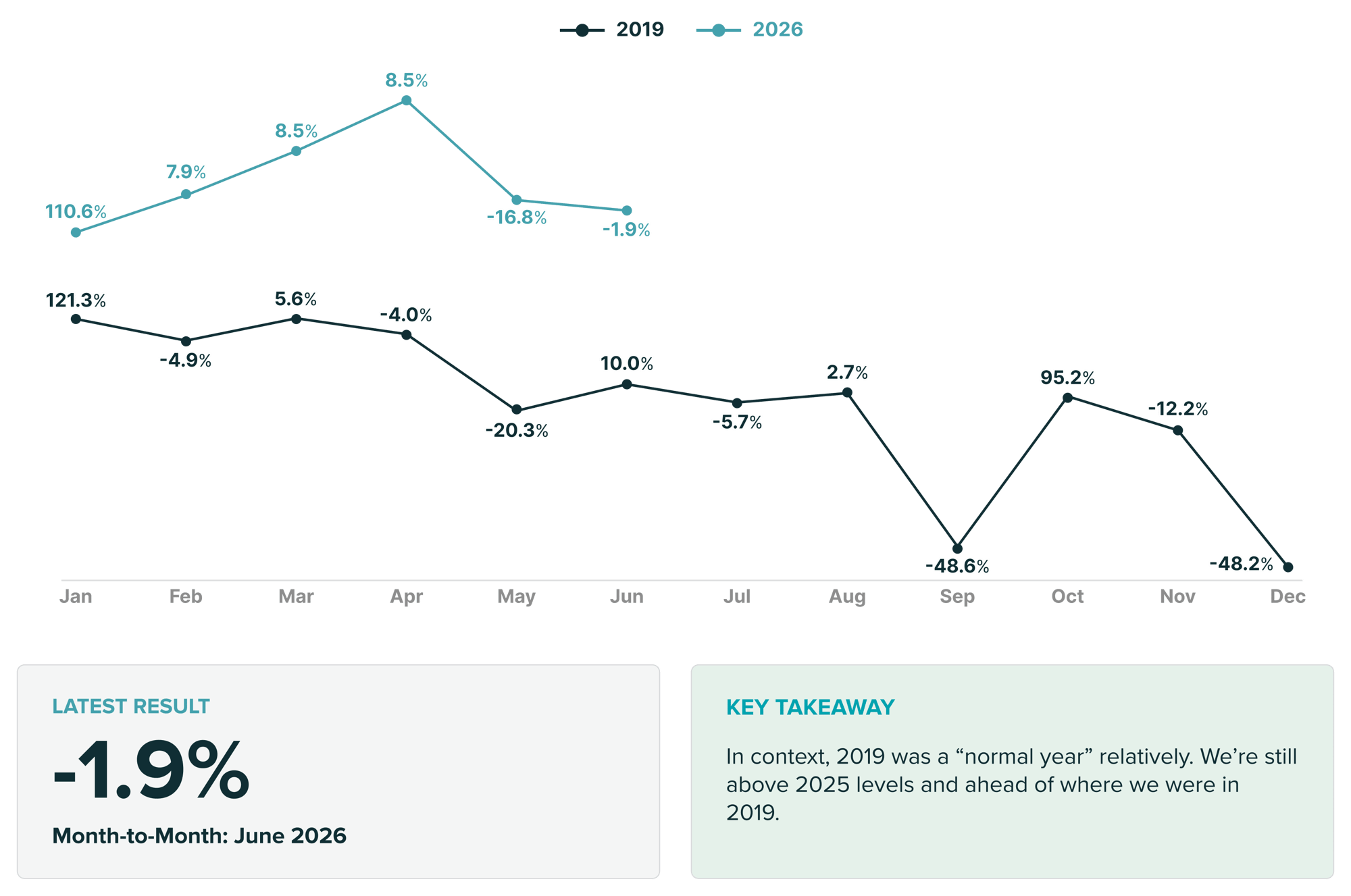
Our Take: Front-end profitability continues to face pressure in 2026, though the sharp declines experienced throughout much of 2025 have begun to level off. Inventory availability is strong (though conditions vary by brand) and affordability challenges continue to impact many consumers. In context, 2019 was a “normal year” relatively. We’re still above 2025 levels and ahead of where we were in 2019. The late 2020–2022 period was marked by peak conditions that have gradually eased in the years since, as supply and demand rebalanced.
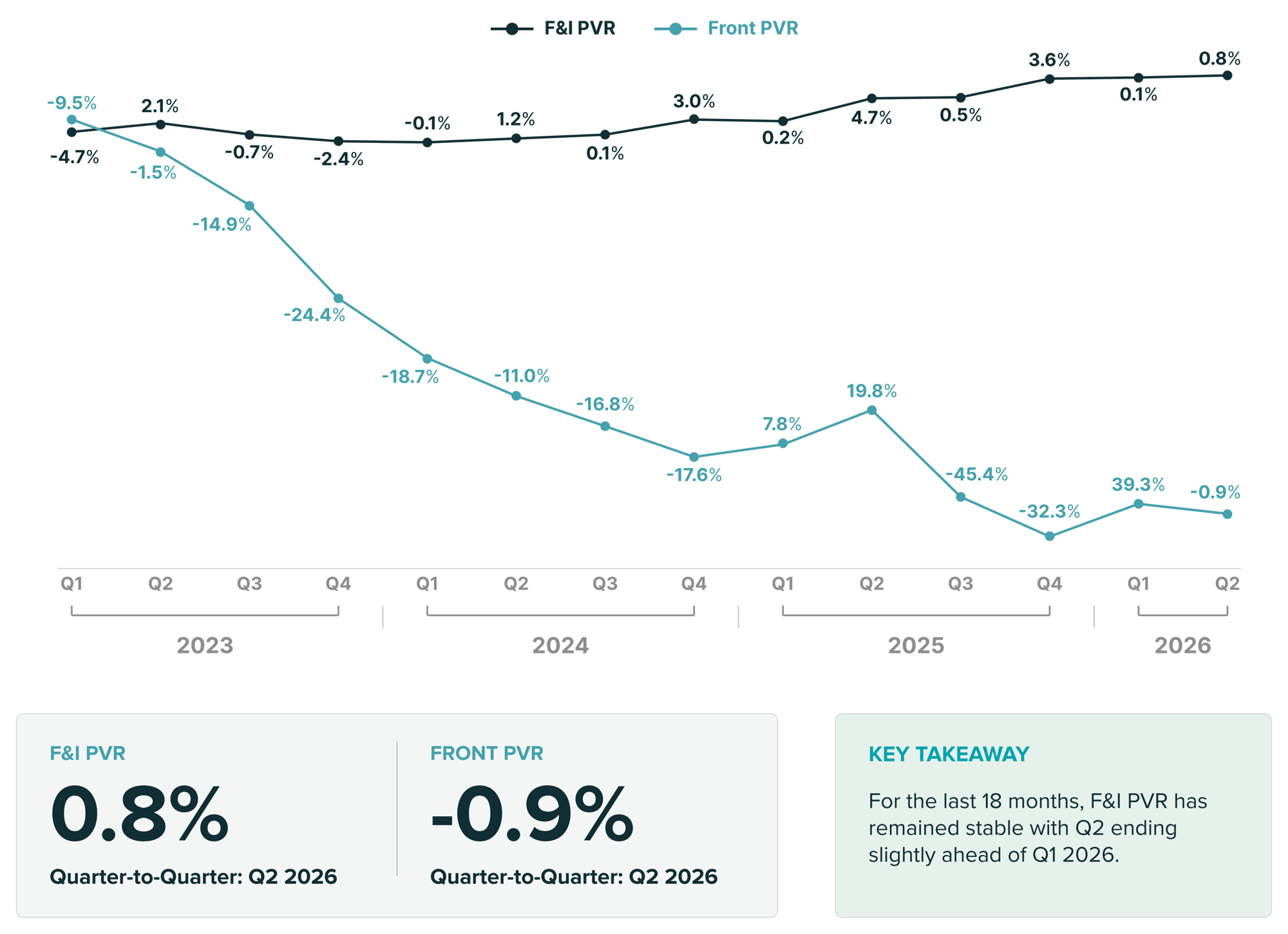
F&I PVR Remains Resilient As Front PVR Declines
For the last 18 months, F&I PVR has remained stable with Q2 ending slightly ahead of Q1 2026.
Our Take: Despite a tougher economic environment for consumers, Q2 2026 car sales held steady with Q2 2025. Many buyers are responding to market and affordability pressures by "delaying purchases, reducing budgets and considering smaller vehicles, but expectations for quality, technology and customer value remain high." In other words, even when affordability is a concern, customers still bring clear wants, needs and desires to the buying process.
That's where a strong sales process in your dealership makes all the difference. Ensure your team has the right sales, product and inventory knowledge in place to ask the right questions, deliver the greatest value and help customers make the most of their budget constraints.
F&I PVR VS. Front PVR % Change
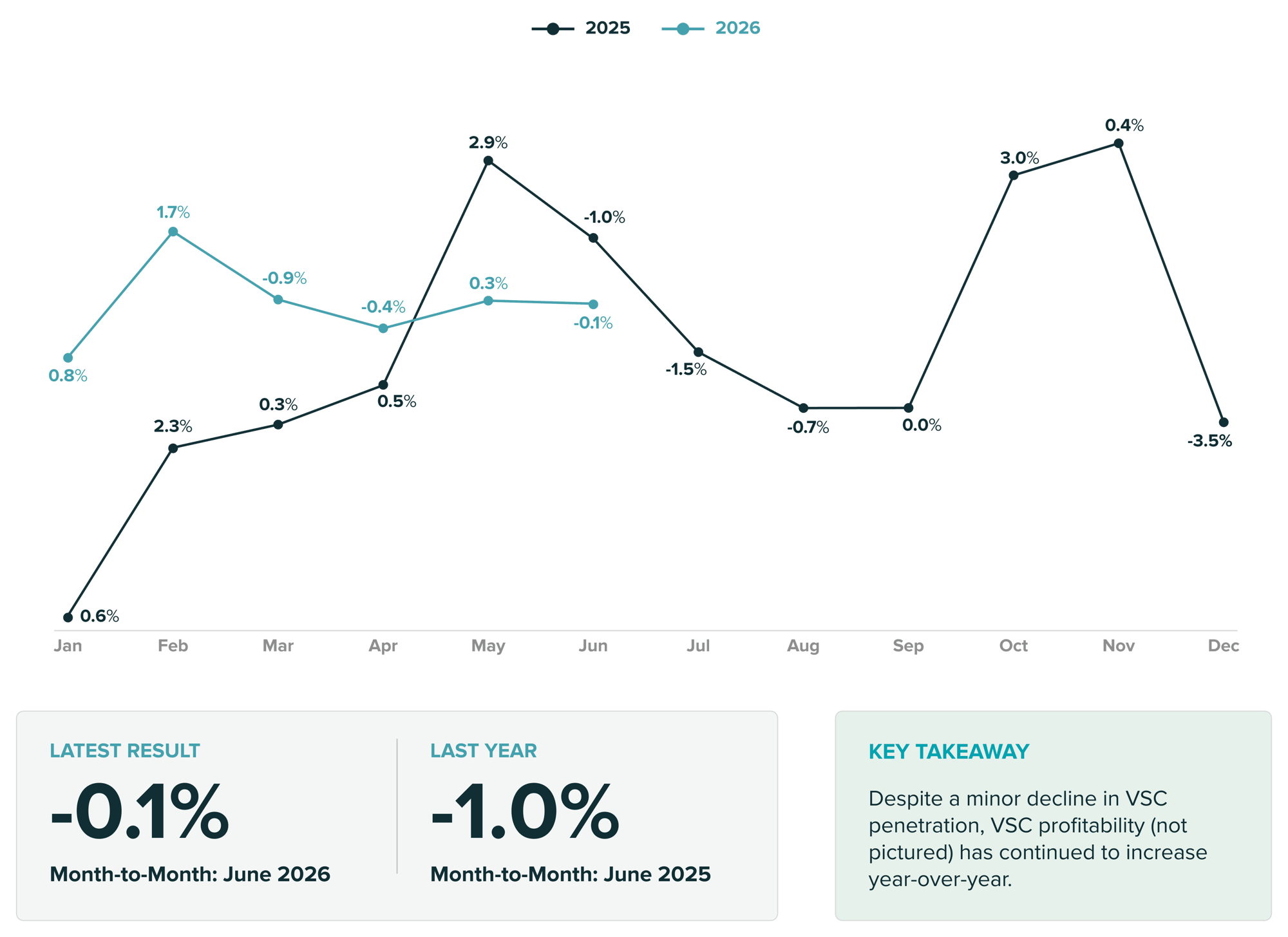
Vehicle Service Contract Penetration Softens in Q2
Throughout the first two quarters of the year, VSC penetration dipped slightly, ending the quarter at –0.1% down from May 2026.
Our Take: Despite a minor decline in VSC penetration, VSC profitability (not pictured) has continued to increase year-over-year. VSC penetration remains an area of focus for the final two quarters. With auto repair inflation continuing to outpace overall inflation, the need for vehicle service contracts remains strong. As dealership teams sharpen and adapt their processes to meet the needs of today's budget-constrained consumer, we're optimistic that VSC penetration will hold steady or even grow in 2026.
VEHICLE SERVICE CONTRACTS
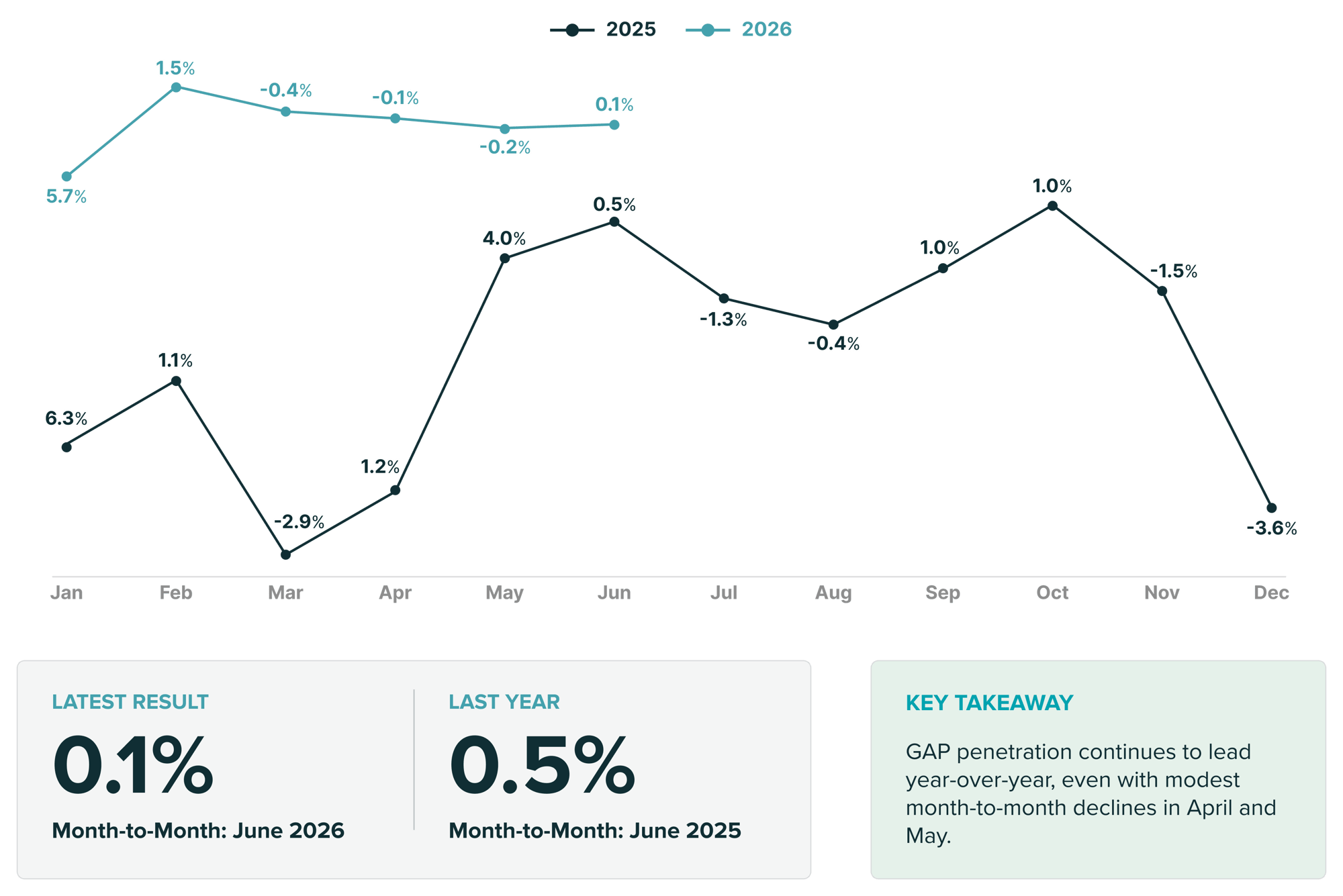
GAP Penetration Above 2025; PPD Ends Q2 Slightly Ahead YOY
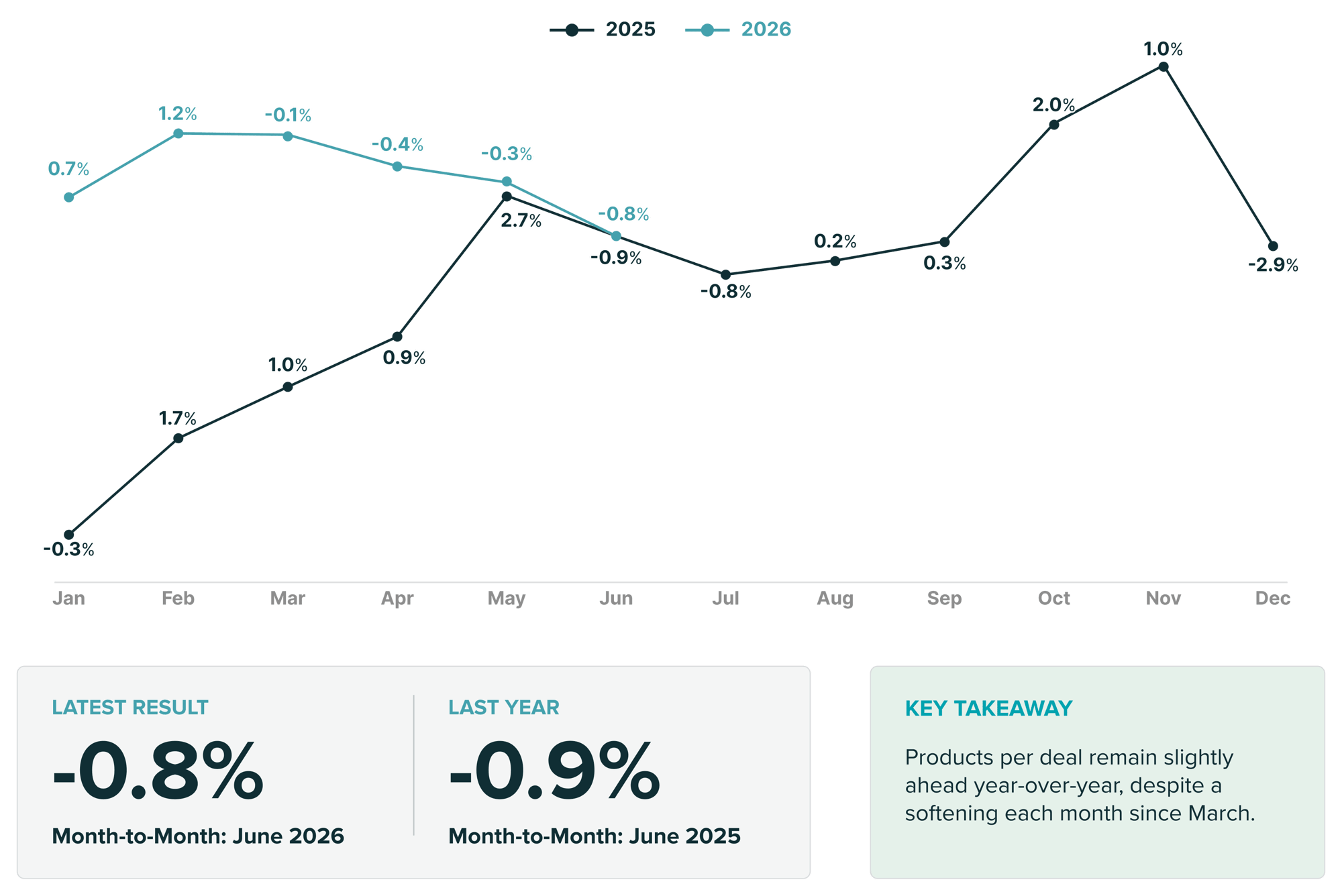
GAP penetration continues to lead year-over-year, even with modest month-to-month declines in April and May. Similarly, products per deal remain slightly ahead year-over-year, despite a softening each month since March.
Our Take: We may see GAP penetration rise next quarter as customers seek lower monthly payments and finance contract terms continue to lengthen. Longer terms can mean more negative equity, making GAP products even more important. As your team offers extended finance contract terms, encourage them to weigh the long-term impact on both the customer and the dealership. A longer term isn't always the best fit: it can mean a longer trade cycle, more interest paid and increased negative equity risk.
At the same time, as gap contracts become more expensive, it's essential that your Business Manager understands how your GAP offering compares to similar products in the marketplace and can clearly explain those differences to customers, helping them find what's truly best for their situation.
GAP
PPD
Economic Factors Shaping Vehicle Sales
Persistently High Interest Rates Create Challenges
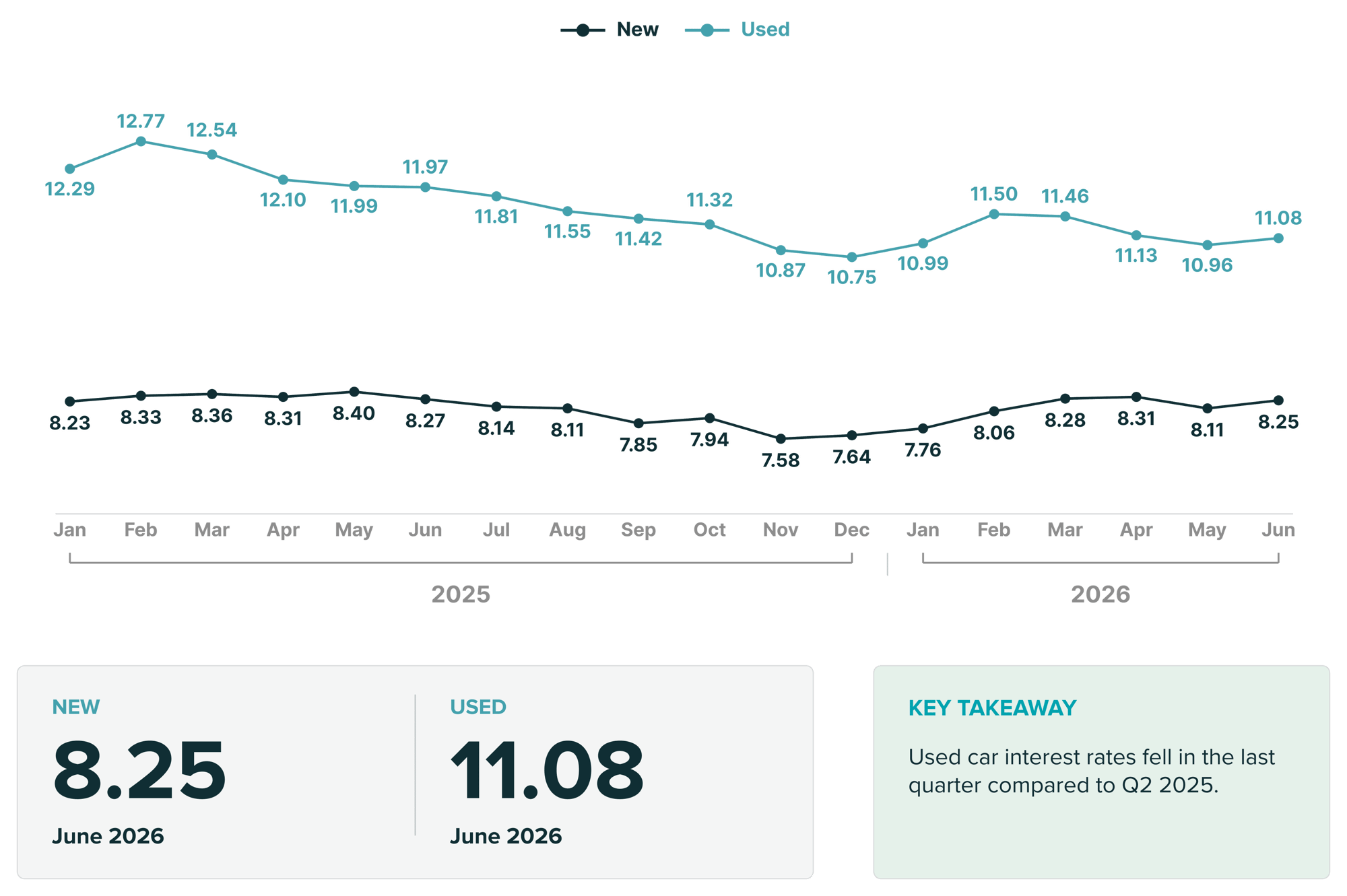
Used car interest rates fell in the last quarter compared to Q2 2025. However, both used (11.08) and new (8.25) rose from a May dip.
Our Take: The Fed held interest rates in a range of 3.5%–3.75% in June, and we do not anticipate cuts during Q3. Customers will continue to be concerned with interest rates through the remainder of 2026. In this environment, it's more important than ever that your sales and finance teams are properly trained and following a consistent process to match each customer with the option that truly fits their needs. Rate sensitivity often opens the door to smarter structuring—whether that's shifting from finance to lease, adjusting the term or rethinking the down payment. A well-trained team knows how to learn each customer's priorities and present the right combination, helping them find a payment they're comfortable with while protecting both the customer and the dealership's long-term relationship.
AVERAGE INTEREST RATES FOR 72-MONTH TERM

New and Used Ratio Begins to Stabilize From Q1 Narrowing
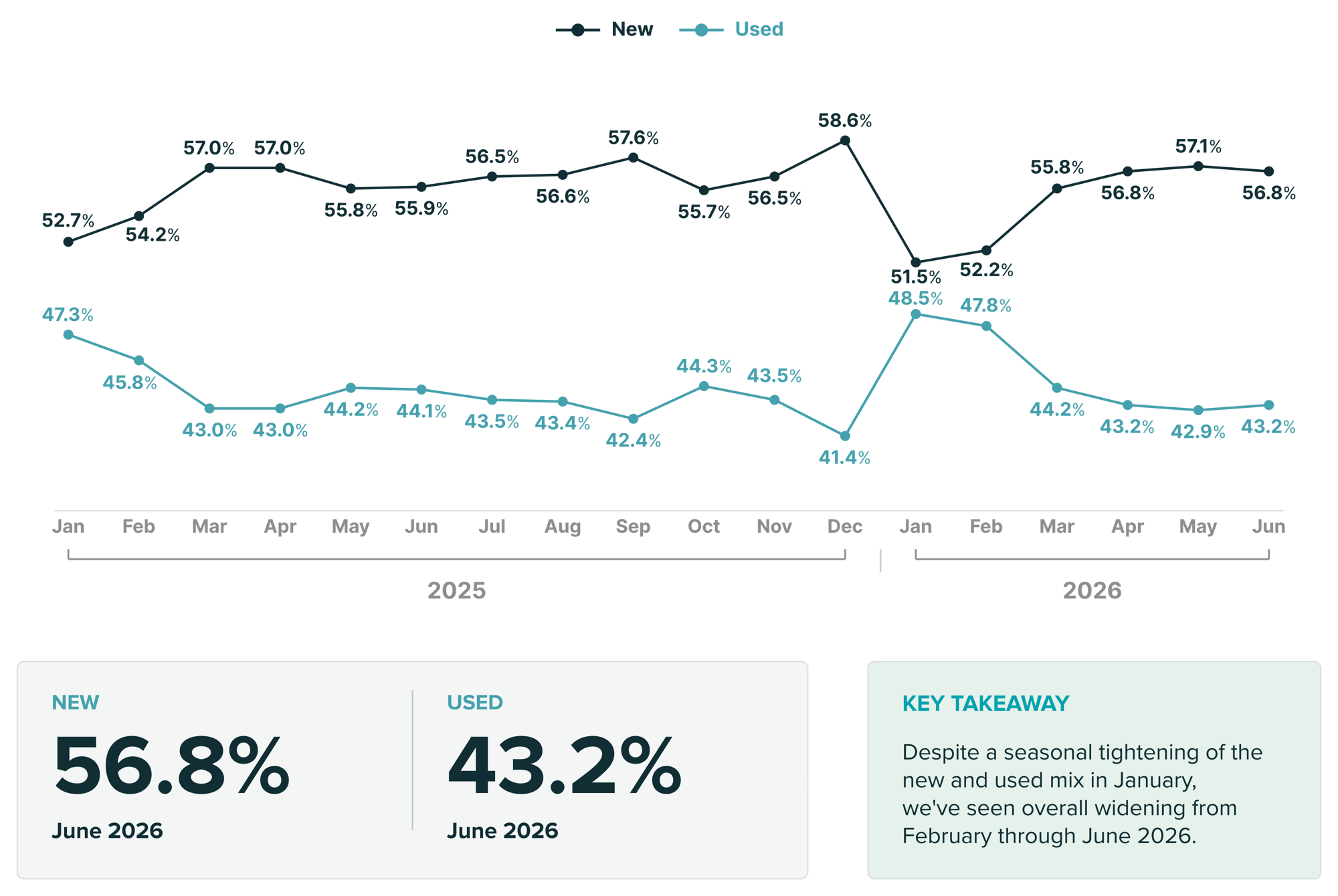
Despite a seasonal tightening of the new and used mix in January, we've seen overall widening from February through June, ending Q2 at 56.8% new and 43.2% used.
Our Take: Looking ahead to the rest of the year, we expect new and used inventory to hold relatively stable. However, changes in manufacturer incentives for new vehicles and growing demand for late-model used vehicles may cause fluctuation. Dealers who move quickly on inventory acquisition and pair that with a strong F&I approach will be best positioned to win. For the upcoming quarter, take a close look at how effectively you’re leveraging off-lease vehicles, trade-ins, purchases, sourcing, reconditioning and early F&I product integration. Also, assess your team’s readiness to handle a growing influx of off-lease EVs and hybrids as the many leased EV's with federal tax credits begin to return to the market.
NEW/USED DEAL %
Deal Mix Sees Little Fluctuation
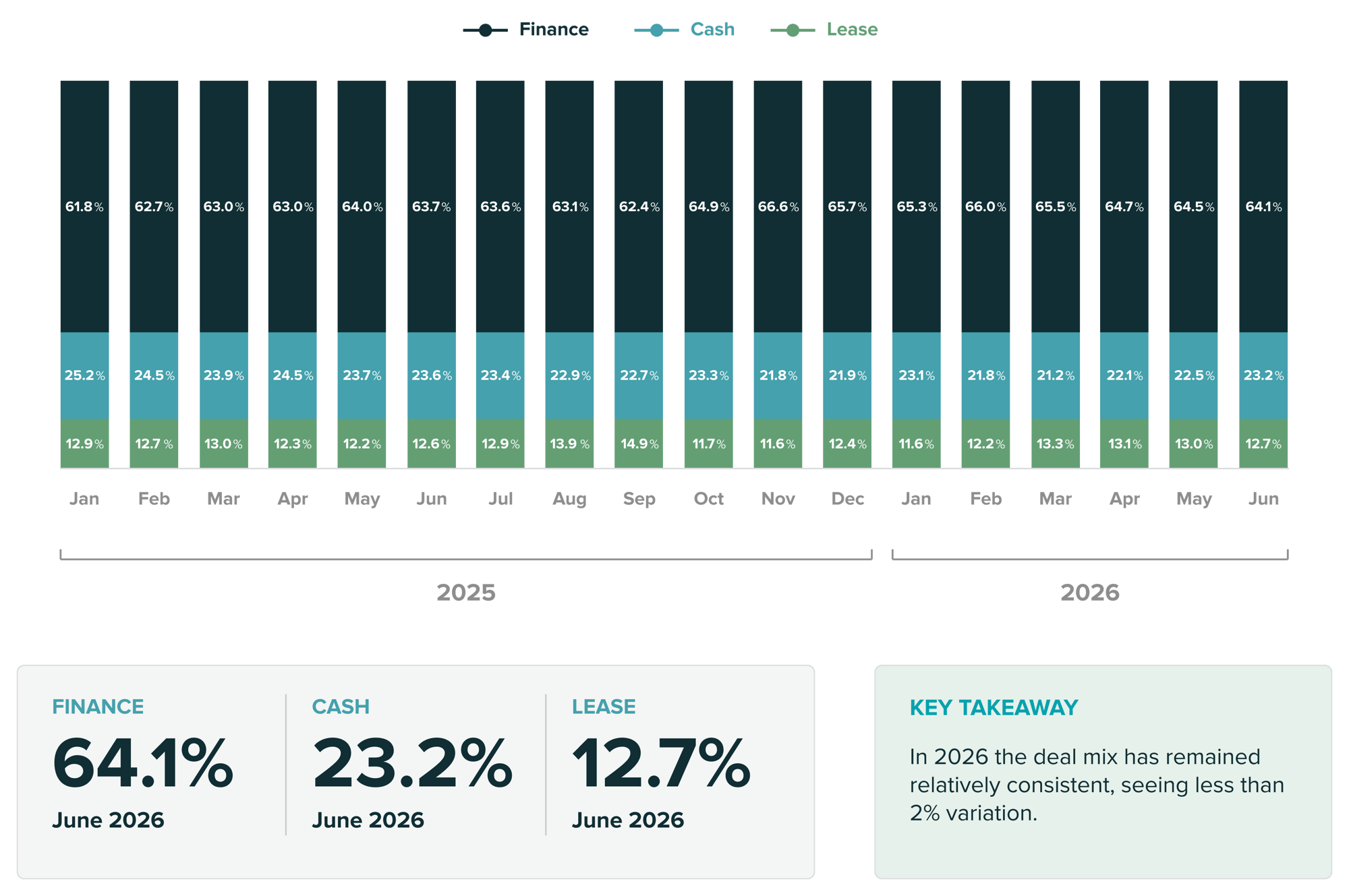
We are very close to where we were last year with this mix, especially with lease penetration ending only .1% different from June last year. In 2026 the deal mix has remained relatively consistent, seeing less than 2% variation. The spike in leases in Q3 last year was related to the EV tax credit expiring, so we don’t anticipate seeing another similar spike during this next quarter.
Our Take: Cash transactions have remained elevated over the past several years, driven by higher interest rates and consumers' efforts to avoid increased financing costs. If rates stay high, cash deals should remain steady. Leasing may fluctuate as incentive structures evolve, but it remains an underused opportunity. Dealers who consistently evaluate all financing paths and train teams to clearly present lease options can better match customer budgets and improve deal flexibility.
FINANCE TYPE DEAL PERCENT
Product Versus Finance Reserve Income Holds Steady
Finance Reserve and Product Income ratios (not pictured) have remained mostly stable over the past 18 months. In June 2026, Finance Reserve made up 38.2%, while Product Income made up 61.8% of total F&I PVR.
SAAR Climbs Despite Q1 Dip
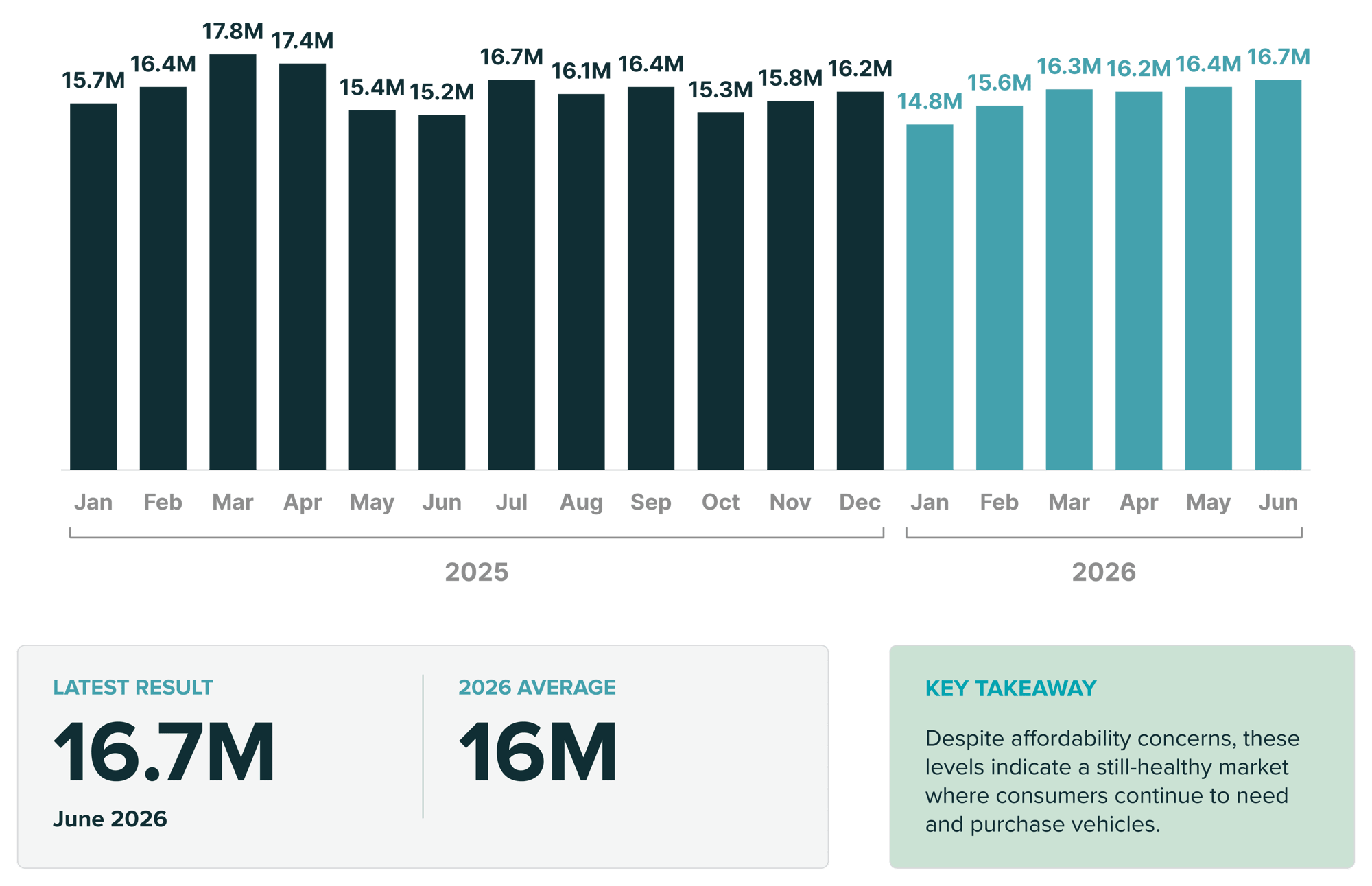
The SAAR is looking healthy - maybe healthier than people expected - as economic and global uncertainty continues to impact consumer purchasing power across the industry.
Our Take: Despite affordability concerns, these levels indicate a still-healthy market where consumers continue to need and purchase vehicles. That said, the growing K-shaped market is worth monitoring. New-car buyers typically maintain an economic advantage over the broader market due to higher price points. This makes it critical to maintain a reliable, affordable used-car inventory to meet varying customer needs and finance options.
SAAR
Advice from a Dealer Performance Manager
Leverage the Service Drive to Increase Contract Sales and Retention
“Right now, most dealerships only involve Finance if a customer asks about a service contract, maintenance or tire & wheel. I think there's an opportunity to be much more intentional. If Service Advisors are trained to recognize opportunities, make introductions to Finance and are even incentivized for those referrals, everyone wins. The dealership creates additional revenue, Service builds stronger customer relationships and Finance sells more products.
Only about 54% of customers with newer vehicles return to the selling dealership for service. That means we're losing almost half of our customers before we ever have another opportunity to earn their business. Something as simple as scheduling the first service appointment before delivery, using personalized follow-ups, sharing repair photos and videos and creating a seamless handoff between Sales, Service and F&I can have a huge impact. The service lane shouldn't just fix cars—it should be viewed as one of the dealership's strongest sales and retention tools.
Build the Bench Before You Need To
The second half of the year isn't the time to realize you don't have anyone ready when a Finance Manager or leader leaves. The best candidates are usually already inside the dealership. They're the salespeople, service advisors or managers who already understand the culture and have earned leadership's trust.
Work with a trusted partner to establish an F&I Apprentice or Bench Program for a structured way to develop future producers. Teach them lender guidelines, compliance, interviews, menu presentations, product knowledge and deal structure and let them gain hands-on experience with real deals. By the time a position opens, they're already prepared instead of starting from scratch.
To me, the dealerships that finish the year the strongest won't necessarily be the ones with the most traffic. They'll be the ones that maximize every opportunity they already have. They'll retain more customers, convert more service visits into future sales opportunities, develop the next generation of leaders and stay disciplined with the fundamentals.”
 |
Shadi Dandan Dealer Performance Manager |
Top Trending News
Hybrid Sales Projected to Rise
In our Q1 report, we mentioned that "as consumers navigate expensive gas prices, some believe that electric vehicles will reemerge to the forefront as a viable alternative.” We also discussed how dealers were evaluating how EVs will fit within their market, customer base and profitability model. We’re now seeing that in the first half of 2026, Americans bought 2.2% fewer new cars, but 9% more hybrids, according to Kelley Blue Book. EV sales are still lower YOY, but dealers should keep EVs and hybrids top of mind. Manufacturers will likely continue with adding hybrid models of their vehicles to appeal to ICE and EV buyer preferences. As gas prices fluctuate, hybrids are increasingly being viewed as a viable, and less expensive, option for certain lifestyles.
Expense Growth is Outpacing Income Growth
Consumers are facing multiple challenges when it comes to affordability. Not only are interest rates high, and tariffs still present (leading to price increases), but income growth has not been on an equally matched trajectory with expenses. The gap has widened to the highest since 2021 according to Cox Automotive. Recognizing the broader financial pressures customers face, from grocery bills to fuel costs, enables your team to adjust its sales approach. Empathy may not be necessary to close a deal, but it's often what separates a one-time sale from a loyal, returning customer.
Preparing For Dealership Success This Year
While the market continues to evolve, opportunity is far from lost. Instead, it’s simply shifting. Dealers who understand their data and respond quickly to changing consumer behavior will be best positioned to outperform. Let this report serve as a guide as you enter Q3:
- Identify gaps
- Double down on what’s working
- Keep the customer experience at the center of every decision
Even as external pressures mount, F&I penetration continues to hold strong—a testament to the resilience of a well-run F&I operation. With the right F&I managers, the right product mix and the right alignment of people, process and technology, dealerships can remain largely insulated from the affordability and macroeconomic headwinds shaping the broader market. A disciplined F&I strategy isn't just a buffer against volatility; it's a durable driver of profitability regardless of what the market delivers.
The remainder of 2026 holds plenty of room for growth. Now is an opportune time to strategize for success alongside your dealership performance partner—refining your approach, sharpening your team's execution and positioning your store to capture every opportunity the next two quarters bring.
Here's to a strong 2026 at your dealership!

×
![]()
.png?width=450&name=JM%26A%20-%20Driving%20Forward%20Blog%20Graphics%20-%2020260504Index%20Thumbnail%20(700x486).png)
 < 1 min read

.png?width=450&name=JM%26A_Healt-Captive-Blog-Image_OG-index-image-v2%20(1).png)